

1. Premise, Thesis and Conclusion: An Introduction to Our Foundational Concepts & Mission - A Premise to Analyzing Muhammad Asad's Commentary on The Quran
A Message From The East Journal & Press | A Curated Journal Exploring The Post-Colonial Literature of Africa, The Indian Subcontinent and The Arabic Speaking World…

Depending on some external factors this may be the first & last essay I publish and therefore I intend to deliver my complete philosophy in one cohesive paper to the best of my ability.*
Foreword and Intention
We begin in the name of God, Master of Existence, Architect of The Universe and The Tailor of Time….
And we dedicate our efforts first and foremost, from beginning to end, in absolute totality for the sake of The Messenger of Allah, Our Noble Son, Slayer of The Noblemen of The Quraysh, Conqueror of Khaybar, The Vanquisher of Idols, and The Prince and Liberator of The Hejaz… The Father to The Fatherless, The Orphan Son to The Grieving Mothers of The Ummah, The Loyal Friend of The Betrayed, The Intercessor, The Mentor to The Lost and My Dear and Most Beloved Brother Whom I Have Never Met….
Ya Rasool Allah, of course there is no hiding from you or God that indeed I have become estranged from you in such fashion it would contend with reason that my fate is any other than the abode of the fire. For my life - one of abject and consistent failure - and for my future which perhaps may never amount to much, I apologize eternally. The gift to have come to know you is the only matter of weight in this wretched existence, though it is a gift I do not deserve and a gift furthermore I have continuously squandered. I intend to lead a discussion on The Quran, of course such an effort is laughable for the likes of myself to pursue. The Quran is the manifestation of all beauty but I am the manifestation of the doubt the angels had when God created our father Adam. Though my peers question such statements, of course you and I and God best of all know the brutal truth of my words, but I have come not to fear what will come of the next life for I worship God not for some petty consideration - but because it is what I must do. Though, Allah has promised to safeguard His religion with or without me - nothing I as an individual will produce is of any weight unless Allah decides through His wisdom to use my efforts as a vessel to communicate truths of which ultimately are not original to anything going on in my mind. What I intend to do, and indeed all I can do is attempt to communicate “the truth” proper - that truth being the tapestry of existence itself. Only in so far as what I bring forward reflects this truth - which is not of what my hands produced - but rather latent in the spine of the universe, shall it resonate in the heart of the reader.
I ask… Allah, cleanse my heart and soul in relation to this effort. If I falter, burn my soul in the next life and force me to drink out of the lake of eternal fire, and if I triumph I ask only to see The Messenger of Allah for even but a moment in the eternal garden.
What is for Allah and His Messenger shall stand the test of time and all else will be burned away in the raging fire of “Allah Hu Akbar” (Iqbal 96)1
And may the eyes of a coward never find rest…
Premise, Thesis and Conclusion
Reason is a subject, or really merely a word in the minds of most which has no real structure behind its initial connotation. The phenomenon of the written word - thought, argumentation, philosophy and the like - are seen by most really as nothing more than displays of rhetorical prowess. We see this on display constantly, an individual who may possess not one iota of legitimate intellectual ability will nonetheless be able to move swaths of people only due to his ability to speak well. I call such a display “spell casting”, perhaps more academically it would be “sophistry”. Sophistry is indeed a critical problem, well what is sophistry? - more accurately asked, what do I mean specifically by the word “sophistry” in a religious context?
I have been brutally critical of the status quo of the ummah for quite some time, though only in the past few years has that critique become something which now is a full bodied skeleton clothed in flesh and skin. Iqbal before me put it best,
“religion without power is mere philosophy” (Iqbal qtd. in Schimmel 127)2
another way of putting an idea attributed to Nietzsche,
“Knowledge kills action; action requires the veils of illusion” (Nietzsche, sec. 7)3.
We see clearly from the life example of The Messenger of Allah a framework and model of behavior which for some reason has been lost in discussions of “The Sunnah”. I don’t mean by the phrase “The Sunnah” the observance of some or the other ritual action - perhaps a extra few rakahs after prayer, or some mode of dress, or whatever is meant by the masses by the word “akhlaq” - I mean rather a holistic inculcation and actualization and realization of the eternal axioms put forth by The Quran lived and translated through the flesh of The Messenger of Allah.
We are presented already from the get go a most critical point of incongruence. When one reads the Shama’il of At Tirmidhi, or any complete work of Seerah - whether written from a historical or a liturgical point of view - we see clearly that those who claim inheritance from The Messenger of Allah (Jāmiʿ al-Tirmidhī, Hadith 2682)4 fail to reflect even a single iota of what is present in the source material.
I must however make a quick assertion to many of my critics. I have come to be known as a “contrarian” of sorts, someone who is unable to be satisfied with anything and endlessly critical of any religious effort - as such, much of what I have to say has lost weight with the laity. It is just “Junaid being Junaid” as I have come to hear. Well, my essays, arguments and point of contention - thoughts formulated over 12 years of intense study mind you - are an unequivocal assertion that what is being done is empirically ineffectual, insincere and wholly insignificant as a result. And furthermore that all such accusations can be proved from the Quran.
The ire which my words earn are in reality the betrayal of the deeply ingrained psychological insecurities latent within the ummah as a whole. For us, we simply want to “do good” - we want to invite as many people as possible to the gathering, curate an experience and not make the atmosphere one of tension. As a result, in my estimation the culture of religious intelligentsia and leadership fall into complacency. Rarely ever does an “imam”, “scholar” or “ustadh” need to justify their positions and their place in the community - rather, the gatherings usually are filled with wide eyed hopefuls being slowly lulled with sweet speech to a point of climatic catharsis wherein the illusion of being “connected to God” will pass over one with tears to boot - though any permanent and lasting spiritual change is nowhere at all to be found.
For those who find my words troubling I harken them to a most critical verse in The Quran,
“Had We bestowed this Qur’ān from on high upon a mountain, thou wouldst indeed see it humbling itself, breaking asunder for awe of God…. And [all] such parables We propound unto men, so that they might [learn to] think.” (Quran 59:21)5
Before we can ask ourselves on the question of “what must be done?” or “how can we make things practical?” or “how can we impact people’s lives?” or “how can we reach people?” etc., etc, we first need to ask ourselves the question as to whether or not we have reached a state of spiritual development wherein any effort we do can be done properly and in earnest - otherwise all we are doing is massaging our ego. Many pose against me that for all my reading I have “done nothing” and neither has “A Message From The East”. A curious accusation to be sure, as the individual lives of every member was radically transformed as a result of the group.
(“A Message From The East” began as a bookclub wherein my close friends explored Post-Colonial Islamic writings from 2024 onwards until now)
The fact of reality is that change only will come from the few, but this is not a promotion of elitism, but rather simply a recognition that those with the heart and mettle to do the work are but of a select few. 114,000 companions are recorded to have been present at The Farewell Pilgrimage of The Messenger of Allah , yet only the names of 2500 are known and most are known only as names in books - as links in chains of narrations. Out of the 2500 only about 50-60 are actually known to have massively impacted the direction of the original story of Islam, in other words only .05% of the companions were needed to actually move the religion from the initial point of revelation to the end and influence the rest such that the religion reached us today. The religion reaches us today by the efforts of merely 2.5% of those present at The Farewell Pilgrimage (Al-Suwaidan)6.
Though, the .05% we really know of were not of the intelligentsia at all. They were “common men” - men of the salt of the earth - one might even say they were simple men. Though, they possessed what is true intelligence, which is mettle in the spine and the willingness to challenge themself.
In other words there were men who were not held up by inhibitions, open minded in the proper sense of the term and when truth was present they took it on heel. Abu Dhar Al Ghiffari, though a criminal in his past life (Al-Bukhari, Hadith 3861)7 - quite literally a career bandit - was a man who, despite his ruggedness and apparent lack of sophistication, possessed more of a sense of truth than the most “learned” of the Quraysh who betrayed The Prophet in the bitter end. For he possessed what most of the intelligentsia do not, which is common sense. Though I digress…
Back to my original point, Allah in a most shocking verse says the following,
“True piety does not consist in turning your faces towards the east or the west – but truly pious is he who believes in God, and the Last Day, and the angels, and revelation, and the prophets; and spends his substance – however much he himself may cherish it – upon his near of kin, and the orphans, and the needy, and the wayfarer, and the beggars, and for the freeing of human beings from bondage; and is constant in prayer, and renders the purifying dues; and [truly pious are] they who keep their promises whenever they promise, and are patient in misfortune and hardship and in time of peril: it is they that have proved themselves true, and it is they, they who are conscious of God.” (Quran 2:177) 8
This most bizarre verse serves first and foremost as an embarrassing foil to what passes for “religious instruction” from the 11th century onwards. Instruction which has propagated, nurtured and inculcated a culture of hermeticism and cultishness - instruction of which over emphasizes outward ritual observances, and pietistic affectations all to bring about a show of “good akhlaq” and the like. Allah in the same verse admonishes in severe terms the notion that righteousness and salah are even connected at all right at the beginning, yet He mentions “who establish prayer” as a definition of the righteous in the latter half of the verse. We see here God displaying and providing to us the formula for genuine change and a framework by which all things may become meaningful.
A formula predicated first upon defining, making clear and living on a definite philosophy whereby one’s thought, attitude and behavior pattern changes such that action - both ritual and vital - are inextricably bound to one another.
Only after mentioning giving “charity of one’s cherished wealth to relatives, orphans, the poor, ˹needy˺ travellers, beggars, and for freeing captives” is salah brought back into the picture - though even so it is coupled again with a mention of charity and the critical importance of keeping one’s word.
We see here between the lines that Allah’s admonishing of the notion that righteousness and salah are connected at all is akin to the beginning portion of the shahada. Allah begins from a point of absolute negation in order to wipe the psychological slate clean from any preconceived notions in order to properly set the stage for how Salah ought to be understood - which is a latter stage to levels of development which first need to be reached in order for the prayer to carry any weight.
In other words we see here Allah clearly making reference to the fact that the fundamental aspects of virtue must be developed before any of such tertiary considerations of ritualism can even honestly enter into one’s conscious mind and it gives us furthermore a sieve wherein we can measure the merit of any effort we come across or embark upon.
The Quran is to us an alien document, I would wager to say not even those who “study it” - in fact sometimes in particular those who “study it” - have never properly engaged with the text in a personal sense. The Quran is to us a document which is locked behind layers and layers of super impositions, of institutionalized preconceptions and frameworks of “orthodoxy” which already color the text past what its etymology says of itself. We are far too formal with God, God the one whom man ought to love in absolute totality. Well to love truly is to have no inhibitions, we see this clearly with the companions of The Messenger of Allah - indeed the “tradition” has become in it of itself an idol the likes of which Al Lat and Uzzah could never have competed with and as a result all of the aforementioned pathologies continue to spread throughout the ummah causing it to die a slow and painful death.
I will harken more on the problem of institutions later as that is far beyond the scope of the present discussion but suffice it to say that what has been lost is the attitude of immediacy. We forget that The Quran, though it be the foundational text of this religion to us, was at the same time a personal revelation from God to The Prophet Muhammad.
A most critical observation graces our souls as a result of this observation…
The Quran reveals to us the unfolding of the development of the personal relationship between The Messenger of Allah and God Himself.
It reveals how God, through His divine tutelage nurtured The Prophet Muhammad from birth to death - inch by inch, through trial and triumph.
What is lost on us now, is the intensity of this relationship, of the magnificent phenomenon which was the development of the personality and character of The Prophet Muhammad from being a quiet shepherd to a warrior king.
We forget, at the beginning Our Messenger was subjugated to an experience of earth shattering trauma when Gabriel first revealed his mission on the mountain. That God called him “The Enwrapped One” (Quran 73:1)9.
That God said directly to The Prophet,
“Thy Sustainer has not forsaken thee, nor does He scorn thee” (Quran 93:3)10.
That just as God through Surat At Taha said to Moses and to us,
“...Fear not! Verily, I shall be with you two, hearing and seeing [all].” (Quran 20:46)11
He is also saying such words directly to The Prophet.
Our Messenger underwent a journey the likes of which no other human being has ever, and will ever again be subjected to. And yet, at the same time he is immediately relatable and understandable - a man one can sympathize with easily. We see through The Quran a humble shepard go from one “enwrapped”, hiding himself out of extreme fear, to one who - with the cooperation of God - defeated the Meccan elite at Badr.
“And yet, [O believers,] it was not you who slew the enemy, but it was God who slew them; and it was not thou who cast [terror into them, O Prophet], when thou didst cast it, but it was God who cast it: and [He did all this] in order that He might test the believers by a goodly test of His Own ordaining. Verily, God is all-hearing, all-knowing!” (Quran 8:17) 12
We then return to the precedent within The Quran to follow The Messenger of Allah:
Surah Al-Ahzab (33:21): “Verily, in the Apostle of God you have a good example for everyone who looks forward [with hope and awe] to God and the Last Day, and remembers God unceasingly.”13
Surah An-Nisa (4:59): “you who have attained to faith! Pay heed unto God, and pay heed unto the Apostle and unto those from among you who have been entrusted with authority; and if you are at variance over any matter, refer it unto God and the Apostle, if you [truly] believe in God and the Last Day. This is the best [for you], and best in the end.”14
Surah An-Nisa (4:80): “Whoever pays heed unto the Apostle pays heed unto God thereby; and as for those who turn away – We have not sent thee to be their keeper.”15
Surah An-Nur (24:54): “Say: ‘Pay heed unto God, and pay heed unto the Apostle.’ And if you turn away [from the Apostle, know that] he will have to answer only for whatever he has been charged with, and you, for what you have been charged with; but if you pay heed unto him, you will be on the right way. Withal, the Apostle is not bound to do more than clearly deliver the message [entrusted to him].”16
Surah Al-Ma’idah (5:92): “Hence, pay heed unto God, and pay heed unto the Apostle, and be ever on your guard [against evil]; and if you turn away, then know that Our Apostle’s only duty is a clear delivery of the message [entrusted to him].”17
We are harkened by God to follow The Messenger of Allah over and over and over again, though due to our psychological insecurities resulting from hundreds of years of colonization - and even more centuries than that of institutionalization - when Allah calls upon us to “obey” God’s Messenger we view the command as only pertaining to legality, modes of dress or this or that behavior which can be delineated from cherry picked hadiths. Though, understanding that The Quran itself is an unfolding dialogue between God and The Prophet we see clearly that to obey and to follow God’s Messenger is to obey and follow the wholeness of not just his example but The Quran proper. It means to follow the sunnah and to follow the man is to enact the following verses at the same time:
Surah Al-Qalam (68:4): “for, behold, thou keepest indeed to a sublime way of life…”18
Surah Al-Imran (3:159): “And it was by God’s grace that thou [O Prophet] didst deal gently with thy followers: for if thou hadst been harsh and hard of heart, they would indeed have broken away from thee. Pardon them, then, and pray that they be forgiven. And take counsel with them in all matters of public concern; then, when thou hast decided upon a course of action, place thy trust in God: for, verily, God loves those who place their trust in Him.”19
Surah Al-Anbiya (21:107): “And [thus, O Prophet,] We have sent thee as [an evidence of Our] grace towards all the worlds.”20
Surah Al-Fath (48:29): “Muhammad is God’s Apostle; and those who are [truly] with him are firm and unyielding towards all deniers of the truth, [yet] full of mercy towards one another.”21
It means that if one fancies themself to be of the sunnah, a most audacious claim, one must be able to honestly say with all self awareness that their character holds a candle to The Prophet in any respect - of course, none of us here have enough arrogance to ever utter the phrase “I am on the sunnah”, we may attempt but this is for God to decide in the end of all ends.
We now embark on this most momentous work, “The Message of The Quran” by Muhammad Asad. There is much I wish to say, but every essay and every speech cannot contain every aspect of my philosophy - but this shall unfold naturally as the sessions go on. Suffice it to say, what Asad wishes to get across is that which I outlined above - immediacy is the central reason and intent behind his effort. The Quran ought to be understood from an etymology first perspective, unhindered by the ijtihad of those who went before, and investigated in a personal sense.
In this group we shall cover a wide array of subjects, but they all are invariably tied together to form a cohesive whole. And so upon this work we shall begin, God Willing…
Written by Junaid Al-Abideen
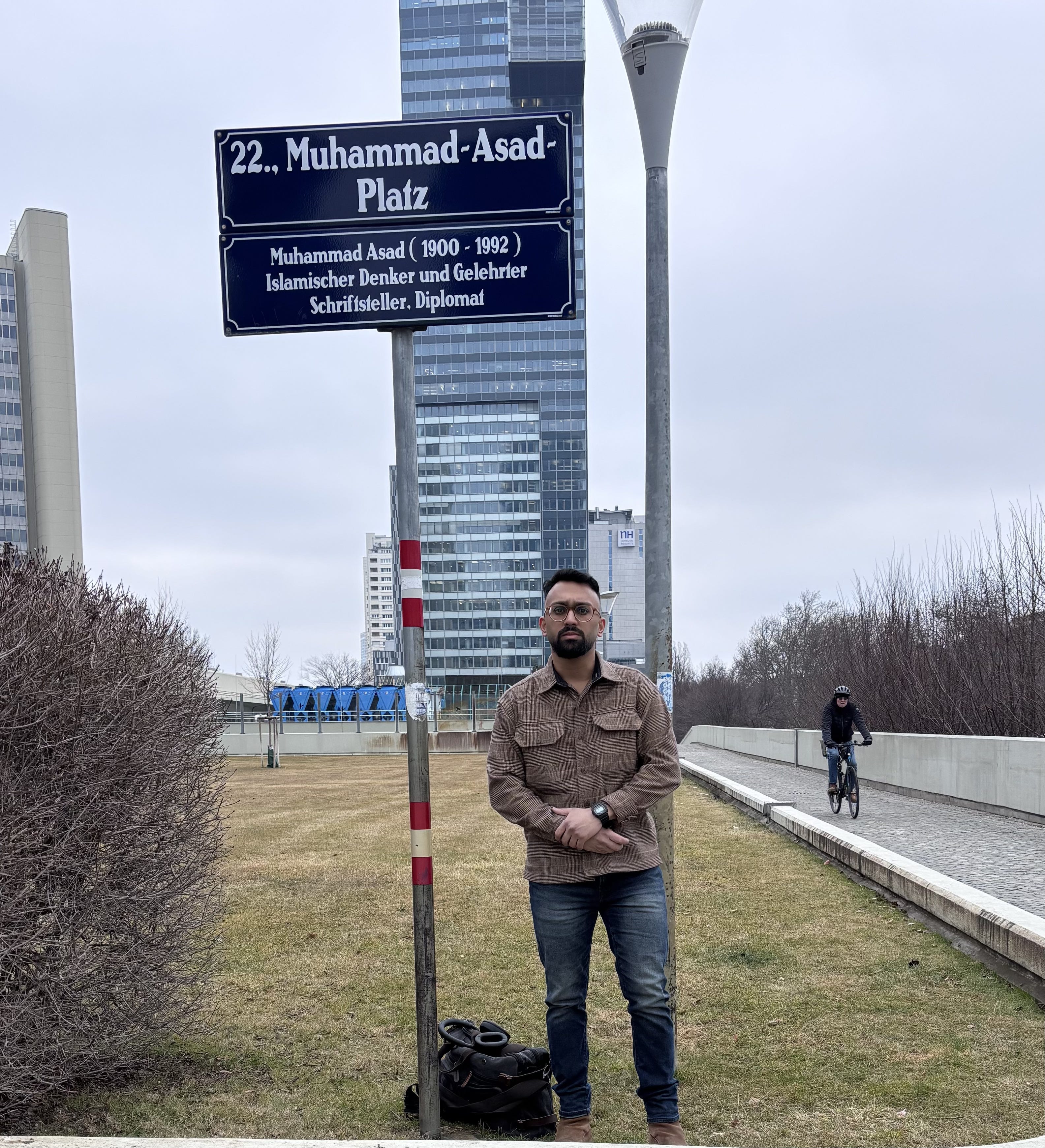
Picture taken February 10th, 2026, 11:19 AM CET at the Muhammad Asad-Platz located at Wagramer Str. 5, 1220 Vienna, Austria
Citations
Iqbal, Muhammad. Shikwah and Jawab-i Shikwah. Translated by Khushwant Singh, Oxford UP, 1981.
Schimmel, Annemarie. Gabriel’s Wing: A Study into the Religious Ideas of Sir Muhammad Iqbal. Brill, 1963.
Nietzsche, Friedrich. The Birth of Tragedy. Translated by Walter Kaufmann, Vintage Books, 1967.
Al-Tirmidhi, Muhammad ibn Isa. Jamiʿ at-Tirmidhi. Translated by Abu Khaliyl, Darussalam, 2007.
Asad, Muhammad, translator. The Message of the Qur’an. Andalus, 1984.
Al-Suwaidan, Tareq. Muḥammad : al-Sīrah al-Muṣawwarah al-Mukhtaṣarah. ibdaʿ, n.d.
Al-Bukhari, Muhammad ibn Ismaʿil. Sahih al-Bukhari. Translated by Muhammad Muhsin Khan, Darussalam, 1997
Asad, Muhammad, translator. The Message of the Qur’an. Andalus, 1984.
Asad, Muhammad, translator. The Message of the Qur’an. Andalus, 1984.
Asad, Muhammad, translator. The Message of the Qur’an. Andalus, 1984.
Asad, Muhammad, translator. The Message of the Qur’an. Andalus, 1984.
Asad, Muhammad, translator. The Message of the Qur’an. Andalus, 1984.
Asad, Muhammad, translator. The Message of the Qur’an. Andalus, 1984.
Asad, Muhammad, translator. The Message of the Qur’an. Andalus, 1984.
Asad, Muhammad, translator. The Message of the Qur’an. Andalus, 1984.
Asad, Muhammad, translator. The Message of the Qur’an. Andalus, 1984.
Asad, Muhammad, translator. The Message of the Qur’an. Andalus, 1984.
Asad, Muhammad, translator. The Message of the Qur’an. Andalus, 1984.
Asad, Muhammad, translator. The Message of the Qur’an. Andalus, 1984.
Asad, Muhammad, translator. The Message of the Qur’an. Andalus, 1984.
Asad, Muhammad, translator. The Message of the Qur’an. Andalus, 1984.